The trust administration portions (Parts 4, 5 and 6) of our video/slideshow presentation on Estate Settlement and Trust Administration in Connecticut have been completed and posted to YouTube.
The videos cover trust administration including a Trustee’s duties, risks that Trustees face, applicable rules and regulations, common problems Trustees face, and Trustee compensation.
You can view Parts 4, 5 and 6 here:
Estate and Trust Administration Part 4 (Trusts): What is a trust? What is trust administration? What are the rules that apply to trust administration? What does a Trustee do? What risks are Trustees exposed to? What are the Trustee’s duties?
Estate and Trust Administration Part 5 (Trusts): Part 5 covers common problems faced by trustees while administering a trust including issues relating to accounting, investments and self-dealing.
Estate and Trust Administration Part 6 (Trusts): Part 6 (the final Part) continues coverage of common problems faced by trustees while administering a trust including potential claims related to contracts that a trustee makes while administering a trust, claims based on a trustee’s negligence and other torts, claims based on environmental contamination of trust real property, and claims related to improper payments and distributions. This Part also includes a brief discussion on Trustee compensation.
To view the complete video starting with Part 1 click on the image below:
We hope you find our Estate Settlement and Trust Administration videos informative.
Notice: To comply with U.S. Treasury Department rules and regulations, we inform you that any U.S. federal tax advice contained in this communication is not intended or written to be used, and cannot be used, for the purpose of (i) avoiding penalties under the Internal Revenue Code or (ii) promoting, marketing or recommending to another party any transaction, tax strategy or other activity.
We frequently post articles relating to estate planning, estate settlement and elder law issues to this blog. We also post notices about our client seminars here. When we do, we send out notices to clients and friends of the firm. If you would like to get our notices, please join our mailing list by clicking below.
New Video Part 3: Estate Settlement and Trust Administration in Connecticut
Part 3 of our video/slideshow presentation on Estate Settlement and Trust Administration in Connecticut has been posted to YouTube.
The video covers judicial accounting requirements, including new rules of practice effective July 1, 2013, Probate Court fees, fees of Executors and Administrators, and attorney fees.
You can view Part 3 (9 minutes) here:
Additional parts will be posted in the future dealing with important principles of trust administration.
For Parts 1 and 2, go directly to the YouTube Playlist by clicking on the image below:
We hope you find our Estate Settlement videos informative. Stayed tuned for the rest of the videos in the series.
Notice: To comply with U.S. Treasury Department rules and regulations, we inform you that any U.S. federal tax advice contained in this communication is not intended or written to be used, and cannot be used, for the purpose of (i) avoiding penalties under the Internal Revenue Code or (ii) promoting, marketing or recommending to another party any transaction, tax strategy or other activity.
We frequently post articles relating to estate planning, estate settlement and elder law issues to this blog. We also post notices about our client seminars here. When we do, we send out notices to clients and friends of the firm. If you would like to get our notices, please join our mailing list by clicking below.
The American Taxpayer Relief Act of 2012 (“ATRA” effective January 1, 2013) will change everything about estate tax planning. We recently updated our Basic Estate Planning Video to reflect ATRA and posted it to YouTube.
Background
April 30, 2013 (Updated April 20, 2015)
We offer seminars to our clients, their advisors, and other friends of the firm, every year. One of the most popular has been our Basic Estate Planning Seminar. On March 14, 2013, we offered our Basic Estate Planning seminar at the Maron Hotel, Danbury, Connecticut. The seminar covered the topics mentioned below.
Those who could not attend the seminar may be interested in taking a look at the Basic Estate Planning video that we recently finished updating to reflect the recently enacted American Taxpayer Relief Act of 2012 (effective January 1, 2013).
The presentation is in 15 parts. Click on the red “Basic Estate Planning after ATRA (15 Parts)”heading below and then click “Play All” under “Basic Estate Planning” at the top of the YouTube page.
Basic Estate Planning after ATRA (15 Parts)
We describe each of the parts below with an individual link to each one.
Part 1: Introduction. Wills and probate property vs. nonprobate property.
Part 2: Beneficiaries, mistakes with nonprobate property, trust basics, guardian appointments, life insurance beneficiary designations, and estate taxes.
Part 3: Wills, the estate taxation of life insurance death benefits, tax issues and asset protection issues relating to Wills, and disclaimer Wills.
Part 4: Formula marital deduction Wills, exemption trusts, risk of disinheriting the surviving spouse as estate tax exemptions increase, the portable estate tax exemption, and asset protection bypass trusts.
Part 5: Formula marital deduction Wills (and exemption trusts) vs. disclaimer Wills (and disclaimer trusts), and common estate planning mistakes.
Part 6: Common estate planning mistakes continued, the duties of an Executor, the duties of the Trustee, the duties of a guardian, planning for post-death cash needs, and the generation skipping tax.
Part 7: Retirement plan accounts (IRAs, 401(k) plans, 403(b) accounts, etc.), estate taxation on retirement plan accounts, the risk of a circular tax on tax problem at death of account owner, life insurance and irrevocable life insurance trusts as a solution.
Part 8: Retirement plan accounts and related income tax issues, effects of beneficiary designations on deferral periods, spouse as beneficiary and tax deferred rollovers, required minimum distributions, and tax treatment of inherited IRAs, and the five year payout rule.
Part 9: Revocable living trusts, the living trust as a Will substitute, probate avoidance, planning for incapacity, and establishing a revocable living trust.
Part 10: Comparison of revocable living trust plan with non-living-trust plan, treatment of lifetime issues, powers of attorney as an alternative to the revocable living trust, and what it means to avoid probate.
Part 11: Comparison continued, avoiding ancillary probate in other states where real property is located, creditors’ claims and safe harbors for the Executor, and income and estate taxes.
Part 12: Comparison (continued), accounting requirements, releases from liability, continuing trusts and continuing probate court jurisdiction, reasons for considering revocable living trusts, management during incapacity, and real property in other jurisdictions.
Part 13: Reasons for considering a revocable living trust (continued), controversial estate plans, probate notice requirements, disruption of support for third parties, probate and related delays, simplifying estate settlement for survivors, nonreasons for considering revocable living trusts, the living trust as tax neutral, and probate court fees.
Part 14: Gift planning, gift and estate tax exemptions, exclusions for small gifts, gifts to education funds (529 plans), exclusions for qualified tuition and medical costs, gift tax marital deductions, gifts to U.S. citizen spouse, and gifts to noncitizen spouse.
Part 15: Gifts of life insurance policies, incidents of ownership, irrevocable trusts as owner, three year rule relating to transfers of life insurance policies, and sophisticated gift techniques (qualified personal residence trusts, grantor retained annuity trusts, valuations for gift tax purposes, gifts to charities and charitable trusts).
Notice: To comply with U.S. Treasury Department rules and regulations, we inform you that any U.S. federal tax advice contained in this communication is not intended or written to be used, and cannot be used, for the purpose of (i) avoiding penalties under the Internal Revenue Code or (ii) promoting, marketing or recommending to another party any transaction, tax strategy or other activity.
We frequently post articles relating to estate planning, estate settlement and elder law issues to this blog. We also post notices about our client seminars here. When we do, we send out notices to clients and friends of the firm. If you would like to get our notices, please join our mailing list by clicking below.
Many estate planning clients come to us with the same question: “How can my estate avoid probate when I die?” There is a common misconception among members of our community that probate is an arduous process that will deplete estate assets and should be avoided at all costs. However, in many cases, the probate process is not much more time consuming or costly than avoiding probate and can provide certain benefits that are unavailable to estates that avoid probate.
When is Probate Necessary?
The first step in understanding the probate process, and when probate is necessary, is to understand the difference between probate property and non-probate property. Probate property is all property which is owned by a decedent, in his or her sole name, and without beneficiary designations. Non-probate property is all other property owned by a decedent such as joint property, retirement accounts with designated beneficiaries and assets owned by a living trust established by a decedent prior to death.
The following are examples of commonly owned probate property and non-probate property:
Probate Property:
Checking account owned solely by the decedent
Vacation home owned solely by decedent
Life insurance owned by the decedent with no designated beneficiary
Automobile owned solely by the decedent
Non-Probate Property:
Retirement account owned by the decedent payable to the decedent’s surviving spouse
Savings account owned jointly by the decedent and the decedent’s surviving spouse
Life insurance owned by the decedent, payable to the decedent’s surviving spouse as the designated beneficiary
Home owned jointly by the decedent and the decedent’s surviving spouse with rights of survivorship (but if owned jointly as tenants-in-common, the decedent’s half of the home would be probate property)
Assets owned by a living trust established by the decedent
When an individual passes away, it is clear who has the authority to access his or her non-probate property. For example, a joint account owner has access to joint accounts; a designated beneficiary of life insurance has the authority to claim the death benefit; and the Trustee of a living trust has authority to access to the assets owned by the trust. No one must be appointed by the Probate Court to have such authority. If the decedent’s estate includes probate property, on the other hand, no one has the authority to access such property and probate becomes necessary.
The Probate Process
In a nutshell, probate is the process of appointing an Executor (or Administrator, if the decedent did not leave a Will), identifying and collecting a decedent’s property, paying the debts, taxes and expenses of the decedent’s estate, and distributing the remaining property to the beneficiaries of the estate.
If the decedent left a Will, the process begins by proving the legal validity of the Will and asking the Probate Court to appoint the Executor of the estate. If the decedent did not leave a Will, the process begins by asking the Court to appoint an Administrator of the estate. Once appointed, pursuant to Connecticut law, the Executor or Administrator will have the duty to complete the following estate settlement steps:
Identify the decedent’s property (probate property and non-probate property) and determine the date-of-death value of all such property;
Take possession of and safeguard the probate property;
Prepare and file an Inventory of all probate property (with date-of-death values) with the Probate Court;
Prepare and file the decedent’s final income tax returns;
Prepare and file the estate’s income tax returns and the estate tax returns;
Identify and pay the claims of creditors, the expenses of estate administration, and taxes;
Prepare and file a Return of Claims and List of Notified Creditors with the Probate Court;
Prepare and file a Final Account (or, for some estates, a Statement in Lieu of Account) with the Probate Court; and
Distribute the remaining property to the beneficiaries of the estate.
The Final Account is a list of all probate property (starting with the Inventory), all income earned on such property (interest, dividends, etc.), all sales, and all debts and expenses paid from the estate. It also includes a list of assets remaining after all estate obligations have been satisfied and a schedule of proposed distributions of the remaining property to the beneficiaries of the estate.
If the decedent left a Will, the beneficiaries of the estate will be determined according to the terms of the Will. If the decedent did not leave a Will (i.e. the decedent died “intestate”), the beneficiaries of the estate will be the decedent’s heirs-at-law in accordance with State statutes (for information about intestacy laws in Connecticut, see “I don’t need a Will”).
After the Final Account has been approved and distributions made, the Executor (or Administrator) files a Closing Account with the Probate Court and the probate process is complete.
It is worth noting that, although the steps applicable in each state are analogous, the details (due dates, forms, filing and probate court fees, etc.) can vary significantly from state to state.
Probate Avoidance
Probate can be avoided with various estate planning techniques (a subject for another article). For some estates, there may be compelling reasons to avoid probate. You should consult an estate planning attorney to determine whether any such reasons apply to you. In many cases, however, avoiding probate merely means avoiding the obligation to file certain documents with the Probate Court (such as the Inventory and Final Account) and payment of related filing fees.
For example, some people avoid probate by establishing living trusts (revocable trusts) and transferring all of their assets to their trust. If a decedent transferred all of his assets to a living trust prior to his death and his estate included no probate assets, probate would not be necessary (barring complicating factors). Nevertheless, the Trustee of the trust would have an obligation to: (i) identify and take possession of the trust assets (if the Trustee has not already done so), (ii) file income tax and estate tax returns, (iii) identify and pay the debts, taxes and expenses of the decedent’s estate, (iv) prepare an account to present to the beneficiaries of the trust, (v) and distribute trust assets in accordance with the terms of the trust. In this example, even though the estate avoided probate, the Trustee still has most of the same obligations as the Executor’s obligations outlined above.
Keep in mind that avoiding probate does not mean the estate avoids estate taxes. Estate taxes are based on the value of a decedent’s gross estate which includes probate and non-probate property. Connecticut, in particular, requires all estates to prepare and file a Connecticut estate tax return even if the value of the estate is less than the Connecticut estate tax exemption and no Connecticut estate tax would be due.
In addition, avoiding probate does not mean an estate avoids the Probate Court fee. The Probate Court charges a statutory fee, based on the value of a decedent’s gross estate, which is assessed when the estate tax return is filed.
Benefits of Probate
The probate process can provide certain benefits and protections that are unavailable to an estate that avoids probate. As discussed above, in Connecticut the Executor or Administrator has a duty to file an Inventory and Final Account with the Probate Court. The Account should document every penny in and every penny out of the estate. Probate Court supervision provides extra protection to estate beneficiaries in the event an Executor or Administrator attempts to abuse its power.
Probate Court supervision can also benefit the Executors and Administrators. Troublesome beneficiaries will have a more difficult time contesting the actions of an Executor or Administrator if the Probate Court has given its “stamp of approval” on the Final Account of the estate.
In addition, probate court procedure limits the time during which creditors of an estate may make a claim for payment by the Executor or Administrator. When the Executor or Administrator is appointed, the Probate Court publishes notice to creditors notifying them to present their claims to the Executor or Administrator. Creditors have 150 days to present a claim. After that period, if distributions have been made, the Executor or Administrator is free from liability from future creditors. Without probate, the decedent’s estate is subject to the applicable statute of limitations which range from 2 to 6 years (subject to tolling statutes) depending on the nature of the claim.
[This article is meant to provide a basic overview of the probate process in the context of estate settlement, including some of the potential benefits of probate. It is not intended to be a complete analysis of the probate process or the pros and cons of probate and probate avoidance. For questions and detailed legal advice, please contact your attorney.]
We frequently post articles relating to estate planning, estate settlement and elder law issues to this blog. We also post notices about our client seminars here. When we do, we send out notices to clients and friends of the firm. If you would like to get our notices, please join our mailing list by clicking below.
Notice: To comply with U.S. Treasury Department rules and regulations, we inform you that any U.S. federal tax advice contained in this communication is not intended or written to be used, and cannot be used, for the purpose of (i) avoiding penalties under the Internal Revenue Code or (ii) promoting, marketing or recommending to another party any transaction, tax strategy or other activity.
We are scheduling group meetings so that interested parties can ask questions related to the subjects in the video. There will be no charge or obligation.
Location: Chipman Mazzucco, Attorneys, Matrix Corporate Center, 39 Old Ridgebury Road, Suite D-2, Danbury, Ct. o6810.
We ask you to click on the link below to complete this survey so that we know what will be convenient for you. It will take only one minute.
Notice: To comply with U.S. Treasury Department rules and regulations, we inform you that any U.S. federal tax advice contained in this communication is not intended or written to be used, and cannot be used, for the purpose of (i) avoiding penalties under the Internal Revenue Code or (ii) promoting, marketing or recommending to another party any transaction, tax strategy or other activity.
We frequently post articles relating to estate planning, estate settlement and elder law issues to this blog. We also post notices about our client seminars here. When we do, we send out notices to clients and friends of the firm. If you would like to get our notices, please join our mailing list by clicking below.
Our Basic Estate Planning Seminar is Now a Screencast
Background
March 28, 2012
We offer seminars to our clients, their advisors, and other friends of the firm, every year. One of the most popular has been our Basic Estate Planning Seminar. We offer it to you now as a screencast/podcast. It is also available on DVD. If you would like the DVD, please contact us (via Chipman Mazzucco).
You can see all 15 parts. Click on the red“Basic Estate Planning (15 Parts)”heading below and then click “Play All” under “Basic Estate Planning” at the top of the YouTube page.
We describe each of the parts below with an individual link to each one. If the full screen button on the bottom right of the icon is not working, click on “For Full Screen Click Here.”
Part 2: Beneficiaries, mistakes with nonprobate property, trust basics, guardian appointments, life insurance beneficiary designations, and estate taxes.For Full Screen Click Here.
Part 3: Wills, the estate taxation of life insurance death benefits, tax issues and asset protection issues relating to Wills, and disclaimer Wills.For Full Screen Click Here.
Part 4: Formula marital deduction Wills, exemption trusts, risk of disinheriting the surviving spouse as estate tax exemptions increase, the portable estate tax exemption, and asset protection bypass trusts. For Full Screen Click Here.
Part 5: Formula marital deduction Wills (and exemption trusts) vs. disclaimer Wills (and disclaimer trusts), and common estate planning mistakes.For Full Screen Click Here.
Part 6: Common estate planning mistakes continued, the duties of an Executor, the duties of the Trustee, the duties of a guardian, planning for post-death cash needs, and the generation skipping tax.For Full Screen Click Here.
Part 7: Retirement plan accounts (IRAs, 401(k) plans, 403(b) accounts, etc.), estate taxation on retirement plan accounts, the risk of a circular tax on tax problem at death of account owner, life insurance and irrevocable life insurance trusts as a solution.For Full Screen Click Here.
Part 8: Retirement plan accounts and related income tax issues, effects of beneficiary designations on deferral periods, spouse as beneficiary and tax deferred rollovers, required minimum distributions, and tax treatment of inherited IRAs, and the five year payout rule.For Full Screen Click Here.
Part 9: Revocable living trusts, the living trust as a Will substitute, probate avoidance, planning for incapacity, and establishing a revocable living trust.For Full Screen Click Here.
Part 10: Comparison of revocable living trust plan with non-living-trust plan, treatment of lifetime issues, powers of attorney as an alternative to the revocable living trust, and what it means to avoid probate.For Full Screen Click Here.
Part 11: Comparison continued, avoiding ancillary probate in other states where real property is located, creditors’ claims and safe harbors for the Executor, and income and estate taxes.For Full Screen Click Here.
Part 12: Comparison (continued), accounting requirements, releases from liability, continuing trusts and continuing probate court jurisdiction, reasons for considering revocable living trusts, management during incapacity, and real property in other jurisdictions.For Full Screen Click Here.
Part 13: Reasons for considering a revocable living trust (continued), controversial estate plans, probate notice requirements, disruption of support for third parties, probate and related delays, simplifying estate settlement for survivors, nonreasons for considering revocable living trusts, the living trust as tax neutral, and probate court fees. For Full Screen Click Here.
Part 14: Gift planning, gift and estate tax exemptions, exclusions for small gifts, gifts to education funds (529 plans), exclusions for qualified tuition and medical costs, gift tax marital deductions, gifts to U.S. citizen spouse, and gifts to noncitizen spouse.For Full Screen Click Here.
Part 15: Gifts of life insurance policies, incidents of ownership, irrevocable trusts as owner, three year rule relating to transfers of life insurance policies, and sophisticated gift techniques (qualified personal residence trusts, grantor retained annuity trusts, valuations for gift tax purposes, gifts to charities and charitable trusts).For Full Screen Click Here.
Notice: To comply with U.S. Treasury Department rules and regulations, we inform you that any U.S. federal tax advice contained in this communication is not intended or written to be used, and cannot be used, for the purpose of (i) avoiding penalties under the Internal Revenue Code or (ii) promoting, marketing or recommending to another party any transaction, tax strategy or other activity.
We frequently post articles relating to estate planning, estate settlement and elder law issues to this blog. We also post notices about our client seminars here. When we do, we send out notices to clients and friends of the firm. If you would like to get our notices, please join our mailing list by clicking below.
Call 203-744-1929 for reservations. For more contact information, go to the end of this post.
The Last Will and Testament is usually the keystone of an estate plan. It contains the most important instructions for your survivors regarding the use of your assets after your death.
Unfortunately, many people are not aware that a Will usually will not control the disposition of nonprobate assets such as life insurance death benefits, retirement accounts such as 401(k) and IRA plans, annuities, jointly owned property and many other benefits provided under plans offered to employees as part of their employment package.
Unless you properly designate beneficiaries for nonprobate assets and coordinate them with the terms of your Will:
• Your estate plan may be largely ineffective • Your heirs may pay taxes that could have been avoided • Family conflict may ensue • A young beneficiary may receive significant assets too soon
In addition, unique income tax rules apply to many nonprobate assets. Without proper planning, income tax saving opportunities can be lost and tax traps may ensnare the unwary.
At the seminar, we will be discussing issues related to planning for nonprobate assets and how to coordinate the disposition of such assets with the terms of your Will (or Will substitute such as a revocable living trust).
The seminar will be on December 8, 2011, at the Matrix Corporate Center, Main Auditorium, First Level, 39 Old Ridgebury Road, Danbury, Connecticut from 5:15 p.m. to 6:45 p.m. The doors will open a little before 5:00. Refreshments will be served.
These seminars are always well attended and space is limited. If you wish to attend, or if others you know are interested in attending, to reserve space call us (203-744-1929) or send an e-mail message to me (Richard Land at rsl@danburylaw.com) or Kasey Galner (at ksg@danburylaw.com) or Lynn D’Ostilio (at lsd@danburylaw.com) containing your name, number attending, telephone number and e-mail address.
We frequently post articles relating to estate planning, estate settlement and elder law issues to this blog. We also post notices about our client seminars here. When we do, we send out notices to clients and friends of the firm. If you would like to get our notices, please join our mailing list by clicking below.
We are pleased to announce that Timothy M. Herring will be re-joining our firm as a Member effective August 1, 2011.
Tim started his legal career with us in 2004. Since then he has devoted his practice to litigation. After a stint in the litigation department of Cummings & Lockwood in Stamford, Connecticut, he returns to us now with even more experience in dispute resolution.
Tim is married and resides in Danbury, Connecticut.
His practice has focused on complex civil litigation in federal and state courts. He represents individuals and companies in a broad range of matters, including closely held business, partnership, and joint venture disputes, employment litigation, landlord/tenant disputes, prosecuting and defending mechanic’s lien foreclosures, home improvement disputes, unfair trade practice claims, real estate disputes, eminent domain proceedings, non-competition agreement violations, probate litigation, commercial real property tax appeals, general contract disputes, and arbitration.
Tim was recently named a “Rising Star” by Super Lawyers Magazine.
Representative Experience
Here are examples of the types of matters Tim has handled:
Successfully defended limited partners sued by a partnership for delinquent capital contributions in excess of $1 million.
Obtained a judgment of dismissal on behalf of a corporation against securities fraud and related claims by a shareholder, and successfully defended the judgment on appeal in the United States Court of Appeals for the Second Circuit.
Obtained a discharge of mechanic’s lien filed by a contractor against a homeowner’s residence.
Successfully foreclosed a preferred ship mortgage on behalf of a Fortune 100 company.
Obtained emergency injunctive relief prohibiting the holder of a power of attorney from exercising his powers as attorney-in-fact in light of questionable financial transactions.
Successfully defended a trustee and investment adviser from breach of fiduciary duty and related claims asserted by beneficiaries.
Successfully resolved a homeowner dispute with the prior owners of a residence concerning undisclosed environmental issues.
Bar Admissions
Tim is a member of the Connecticut bar, and is admitted to practice before the United States District Court for the District of Connecticut and the United States Court of Appeals for the Second Circuit.
Education
Tim received his B.A., cum laude, from George Washington University, where he graduated with Honors Program Distinction. Tim earned his Juris Doctor, cum laude, from the University of Connecticut School of Law. While at UConn, Tim was an editor of the Connecticut Law Review and a member of the Connecticut Moot Court Board.
Membership
Tim is a member of the Connecticut Bar Association and the Raymond E. Baldwin American Inns of Court.
Other Members of the CMLP Litigation Group
Tim is only the most recent addition to our firm’s litigation group. Other litigators are:
We frequently post articles relating to estate planning, estate settlement and elder law issues to this blog. We also post notices about our client seminars here. When we do, we send out notices to clients and friends of the firm. If you would like to get our notices, please join our mailing list by clicking below.
 Posted on 11/10/2013 by Richard S. Land, Member, Chipman, Mazzucco, Land & Pennarola, LLC.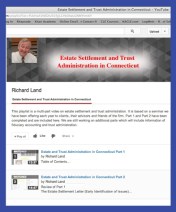


 Join Email List



 Chipman Mazzucco Emerson Estate Planning and Elder Law